How This Site Is Built — A Modern Jamstack Stack
Date Published
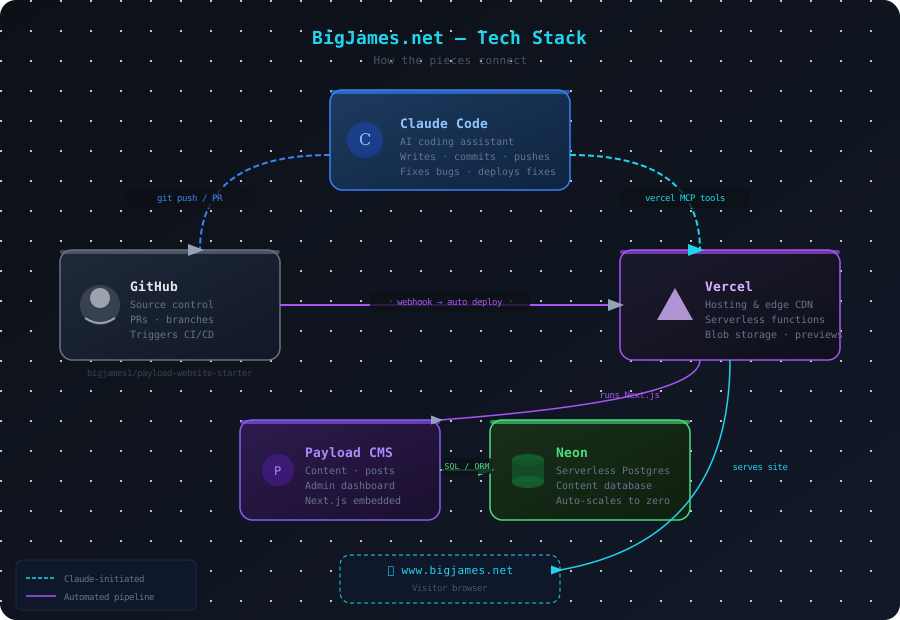
Building a personal blog in 2026 means you get to stand on the shoulders of some seriously impressive infrastructure — all of it free or near-free at hobbyist scale. This site runs on a stack that would have required a full DevOps team a decade ago. Today it's wired together in an afternoon. At the foundation is Payload CMS, an open-source, TypeScript-native headless CMS that embeds directly inside a Next.js app. There's no separate CMS server to manage — the admin dashboard, the API, and the public-facing website all live in the same codebase and deploy as a single unit.
That codebase lives on GitHuband deploys automatically to Vercel on every push. Vercel's edge network handles the heavy lifting: serverless functions spin up on demand to render pages, Vercel Blob Storage holds uploaded images and media, and preview deployments mean every branch gets its own live URL to review before anything hits production. The build pipeline is zero-config — push a commit, Vercel detects the Next.js project, builds it, and has it live globally in under two minutes. For a site like this, that kind of CI/CD would have been a weekend project to set up manually not long ago.
The database is Neon, a serverless PostgreSQL provider that scales down to zero when nobody is visiting and spins back up in milliseconds when they are. Payload uses Neon as its data store through a standard Drizzle ORM layer — all the posts, pages, navigation globals, and media metadata live there. Because it's real Postgres, there's no vendor-specific query language to learn and no artificial limits on schema design. The SSL connection is handled automatically, and branching the database alongside a feature branch is a first-class feature if you need it.
What makes this whole setup a little unusual is how it was built. Claude Code — an AI coding assistant — wrote most of the customization, fixed the deployment errors, configured the storage adapter, generated the OG preview image, and pushed every change through git directly to GitHub. It can read the codebase, reason about what needs changing, edit files, commit, and push — operating as a collaborator rather than just an autocomplete. The result is a blog about ham radio and tech that was itself assembled using some of the most interesting tech around right now. The diagram below shows how all the pieces talk to each other.